
Summary (TL;DR)
- If you are searching for Form 15G for PF withdrawal or Form 15H for PF withdrawal, note that these declarations have now been replaced by Form 121 for eligible EPF withdrawals.
- Form 121 is used to request no TDS deduction where applicable.
- It is generally relevant only if:
- You are withdrawing PF before 5 continuous years of service,
- Withdrawal amount is ₹50,000 or more, and
- Your total taxable income is below the exemption limit.
- Filing Form 121 avoids TDS deduction, but does not automatically make the withdrawal tax-free.1232
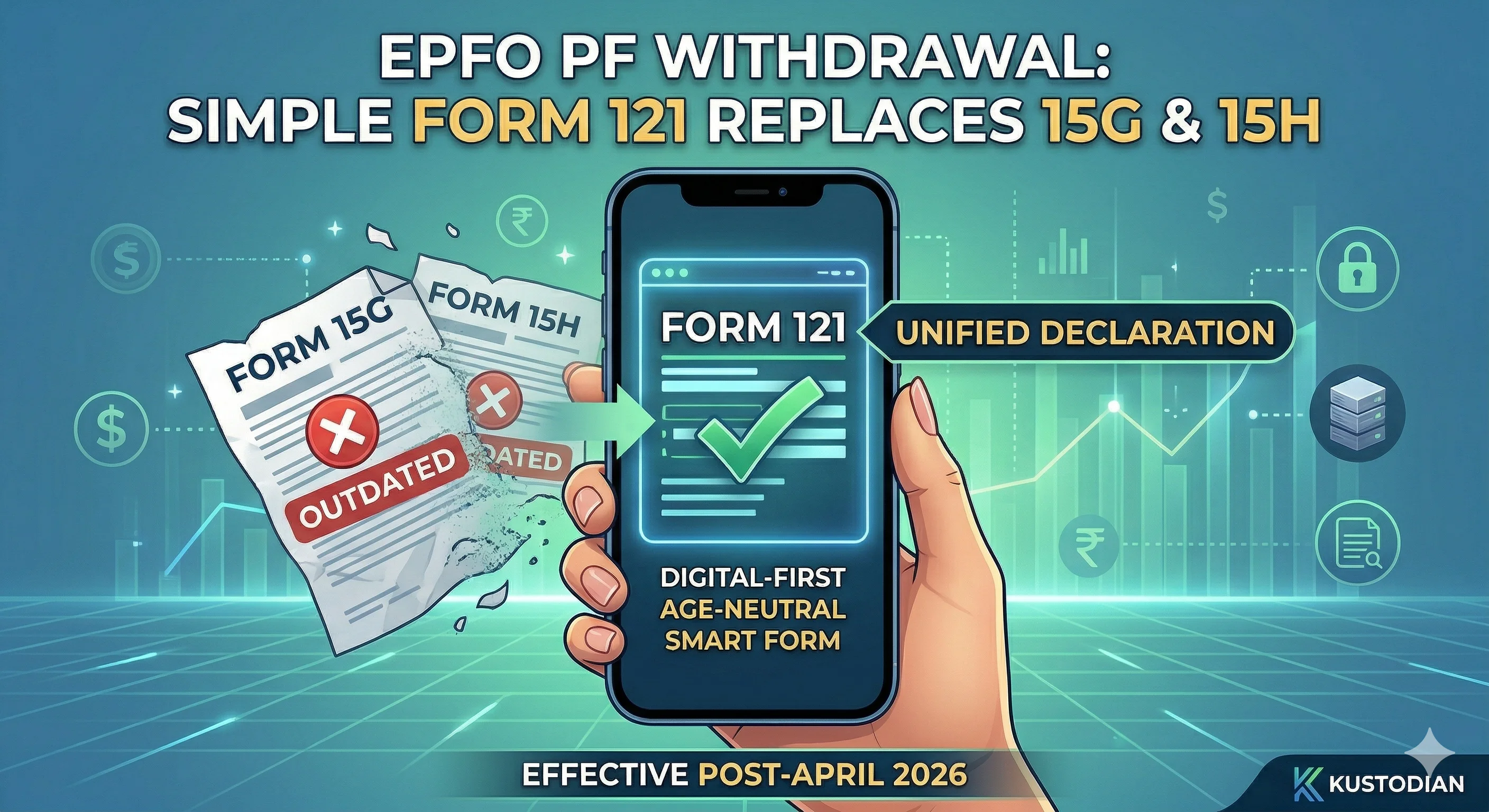
Table of Contents
- Looking for Form 15G / 15H for PF Withdrawal? Here’s What Changed
- What Is Form 121?
- When Is Form 121 Required for PF Withdrawal?
- EPF TDS Rules Explained
- Why TDS Still Gets Deducted for Many Eligible Members
- How to Submit Form 121 on the EPFO Portal
- FAQs
Looking for Form 15G / 15H for PF Withdrawal? Here’s What Changed
For many years, EPF members used:
- Form 15G (for eligible individuals below 60)
- Form 15H (for eligible senior citizens)
to request that no TDS be deducted on PF withdrawal.
As of 2026, these have been replaced by Form 121 for this purpose.
So if you are following an older guide mentioning Form 15G / 15H for PF withdrawal, the underlying tax logic remains similar, but the declaration process has changed.
Official reference: See the Income Tax Department Form 121
Official FAQs: https://www.incometaxindia.gov.in/documents/d/guest/form-121-faqs
What Is Form 121?
Form 121 is the declaration now used by eligible EPF members to request that no TDS be deducted on certain PF withdrawals. It replaces the older Form 15G / 15H workflow with a unified declaration process. The objective is to reduce confusion and streamline verification.
Form 121 isn't just a name change; it is a smarter, unified declaration. Unlike the old system, where you had to choose between 15G (under 60) and 15H (senior citizens), Form 121 is age-agnostic, serving all resident individuals and HUFs.
Key features of the new form include:
- ITR Integration: You now need to provide ITR acknowledgment details for the last two tax years to prove your income eligibility.
- The UIN System: Every submission generates a 26-character Unique Identification Number (UIN), allowing the Income Tax Department to track declarations in real-time.
- Legal Framework: This change is governed by the updated Income Tax Rules, 2026.
When Is Form 121 Required for PF Withdrawal?
You generally need Form 121 only if all of the following apply:
| Condition | Requirement |
| Service Duration | Less than 5 continuous years |
| Withdrawal Amount | ₹50,000 or more |
| Total Taxable Income | Below applicable exemption limit |
If any of these do not apply, Form 121 is usually not needed.
EPF TDS Rules for 2026
| Scenario | TDS Applicable? | Action Needed |
| 5+ Years Continuous Service | No | None |
| <5 Years + Withdrawal Below ₹50,000 | No | None |
| <5 Years + ₹50,000+ + No Form 121 | Yes | TDS Deducted |
| <5 Years + ₹50,000+ + Eligible + Form 121 Submitted | Usually No | Submit Form 121 |
TDS on PF withdrawal is governed broadly under Section 192A of the Income Tax Act.
Important: Form 121 Prevents TDS — It Does NOT Automatically Make PF Withdrawal Tax-Free
This is one of the most misunderstood parts of PF withdrawal taxation.
Submitting Form 121 means:
EPFO may not deduct tax upfront.
It does not mean:
The withdrawal is automatically exempt from tax.
If your final income for the year exceeds exemption limits, you may still need to pay tax while filing your ITR.
⚠️ Warning: The "Name Mismatch" Trap. Even with a valid Form 121, a minor mismatch between your PAN and Aadhaar (like a missing middle name) can cause the system to ignore your declaration and higher TDS rates may apply. Click here to run a KYC Health Check before you submit your claim
Why TDS Still Gets Deducted for Many Eligible Members
Even members who appear eligible often face TDS due to backend record issues.
This is where most PF withdrawal problems occur.
1. Previous PF Accounts Were Never Merged
If you changed jobs but did not transfer earlier PF balances:
- EPFO may not count prior service
- Your service tenure may appear shorter
Result: System may incorrectly treat withdrawal as taxable.
Related: How to Merge Multiple PF Accounts
2. PAN Is Not Properly Verified
Even if PAN is added:
- It may remain unverified in backend systems
- Validation may fail during claim processing
Check via the official Employees' Provident Fund Organisation Member Portal: https://unifiedportal-mem.epfindia.gov.in/memberinterface/
3. PAN / Aadhaar / EPFO Name Mismatch
Small mismatches often invalidate declaration processing.
Examples include:
- Initial vs full name
- Missing surname
- Different spelling format
4. Incorrect Income Declaration
Submitting Form 121 despite exceeding exemption eligibility can create:
- Tax notices
- Interest liability
- Future scrutiny
How to Submit Form 121 on the EPFO Portal
This is a major transition for the tax year 2026-27. Since the Income Tax Rules, 2026 (specifically Rule 211) officially merged Form 15G and 15H into the unified Form 121, the EPFO portal has updated its interface to reflect this "One-Form" policy.
🛠 How to Submit Form 121 on the EPFO Portal (Step-by-Step)
The submission of Form 121 is now integrated directly into the Online Claim workflow. You no longer need to figure out which form applies to your age; the system handles the logic based on your profile.
Step 1: Portal Access & Entry
- Action: Log in to the EPFO Member Unified Portal.
- UAN Credentials: Enter your UAN and Password.
- Verification: Complete the CAPTCHA and the mandatory Aadhaar-linked OTP (a security standard as of late 2025).
Step 2: Service & KYC Health Check
Before initiating the claim, you must verify your eligibility.
- Navigate to: Manage > KYC.
- Verification: Ensure your PAN and Bank Account are marked as "Verified" by the department. If they show as "Pending" or "Rejected," the Form 121 option will be disabled.
- Service History: Go to View > Service History. If your total service is less than 5 years and the withdrawal is >₹50,000, you must proceed with Form 121 to avoid the 20% TDS.
Step 3: Initiating the Claim
- Path: Go to Online Services > Claim (Form-31, 19, 10C & 10D).
- Bank Verification: Enter the last 4 digits of your linked bank account and click Verify.
- Certificate of Undertaking: Accept the "Terms and Conditions."
Step 4: The Form 121 Declaration Section
Once you select your claim type (e.g., Only PF Withdrawal - Form 19), a new section for Form 121 will appear.
- The "Upload" vs. "Digital" Toggle: Most members can now fill a Simplified Digital Declaration directly on the screen.
- Details Required: * Estimated Total Income: Include the PF withdrawal amount plus your other earnings for the year.
- Previous Tax Year Info: You will need the ITR Acknowledgment Numbers for the last two years (as per the new 2026 compliance rules).
- Form Count: The total number of Form 121s you’ve filed with other deductors (like banks for FD interest) this financial year.
Step 5: Final Submission & UIN
- Authenticate: Click on "Get Aadhaar OTP."
- Submit: Enter the OTP. Upon success, the portal will generate a 26-character Unique Identification Number (UIN).
Note: Save this UIN. It is your proof that the EPFO has recorded your request for "No TDS."
Before Filing Form 121: Quick Checklist
| Verify This | Why It Matters |
| Old PF Accounts Merged | Ensures service continuity is counted |
| PAN Verified | Needed for declaration validation |
| Aadhaar Linked | Required for OTP authentication |
| Names Match Across Records | Prevents rejection |
| Income Eligibility Confirmed | Avoids incorrect filing |
| Last 2 Years ITR Info | Form 121 requires previous acknowledgment numbers for validation. |
| UIN Generation | Ensure your portal generates a 26-character UIN upon submission; without it, the form isn't tracked. |
Even small record mismatches can impact the final amount credited to your account. Most PF withdrawal rejections happen because of "Backend Record Mismatches" that are invisible to the user. From merging old accounts to correcting name mismatches, we ensure your Form 121 is ironclad.
Schedule a Pre-Withdrawal Consultation with Kustodian
FAQs
General Eligibility & Use
- Is Form 15G still valid for PF withdrawal?
No. For all eligible PF withdrawal declarations, Form 15G and Form 15H have been replaced by Form 121. - Can I still use the old Form 15G / 15H guides?
Only for understanding the general logic (e.g., withdrawing before 5 years). The actual declaration process and form structure now follow the Income Tax Rules, 2026. - I am over 60. Do I still use Form 121?
Yes. Form 15H is officially retired. Form 121 is now a unified, age-neutral form for all resident individuals and HUFs seeking a TDS waiver. - Can NRIs file Form 121 for PF withdrawal?
No. Form 121 is strictly for Resident Individuals. NRIs are subject to TDS as per DTAA rates or Section 195 of the Act.
Technical & Compliance Queries
- Does Form 121 guarantee zero TDS?
Not necessarily. If there is a backend mismatch in your name (Aadhaar vs. PAN) or if your service history isn't merged, the system may override the declaration and deduct tax. - What if I don't have ITR acknowledgment numbers for the last 2 years?
This is a new mandatory field under Rule 211. Failing to provide these may flag your claim as "High-Risk," potentially resulting in a standard TDS deduction. - What if TDS is deducted despite filing Form 121?
You cannot get a refund from the EPFO once the tax is deposited. You must claim it as a refund while filing your Income Tax Return (ITR) for the 2026-27 year. - Is the ₹50,000 limit still the same in 2026?
Yes. The threshold for TDS on EPF withdrawals remains at ₹50,000 for members with less than 5 years of continuous service.
Need Help Before You Withdraw?
Many PF withdrawals get delayed or deducted unnecessarily because of:
- Unmerged PF accounts
- Incorrect service history
- KYC mismatches
- Backend validation issues
If your PF withdrawal has been delayed, rejected, or deducted unexpectedly, it is often due to underlying record issues rather than the form itself. Identifying these early can help avoid unnecessary delays or deductions.


